

Rigging Is Not Where You Save Money
Rigging is the least visible part of an event and the part with the highest stakes. When it is done well nobody in the audience thinks about it once. That invisibility is exactly why it tends to be the first thing questioned when a budget needs trimming, and it is the wrong place to look.
Everything suspended above a room full of people is a structural decision: the lighting, the screens, the videowall, the truss the whole thing hangs from, the motors that lift it, and the points in the building it all connects to. Getting that right is engineering, not equipment rental.
What rigging actually covers
At a typical corporate event, rigging is responsible for several separate things at once.
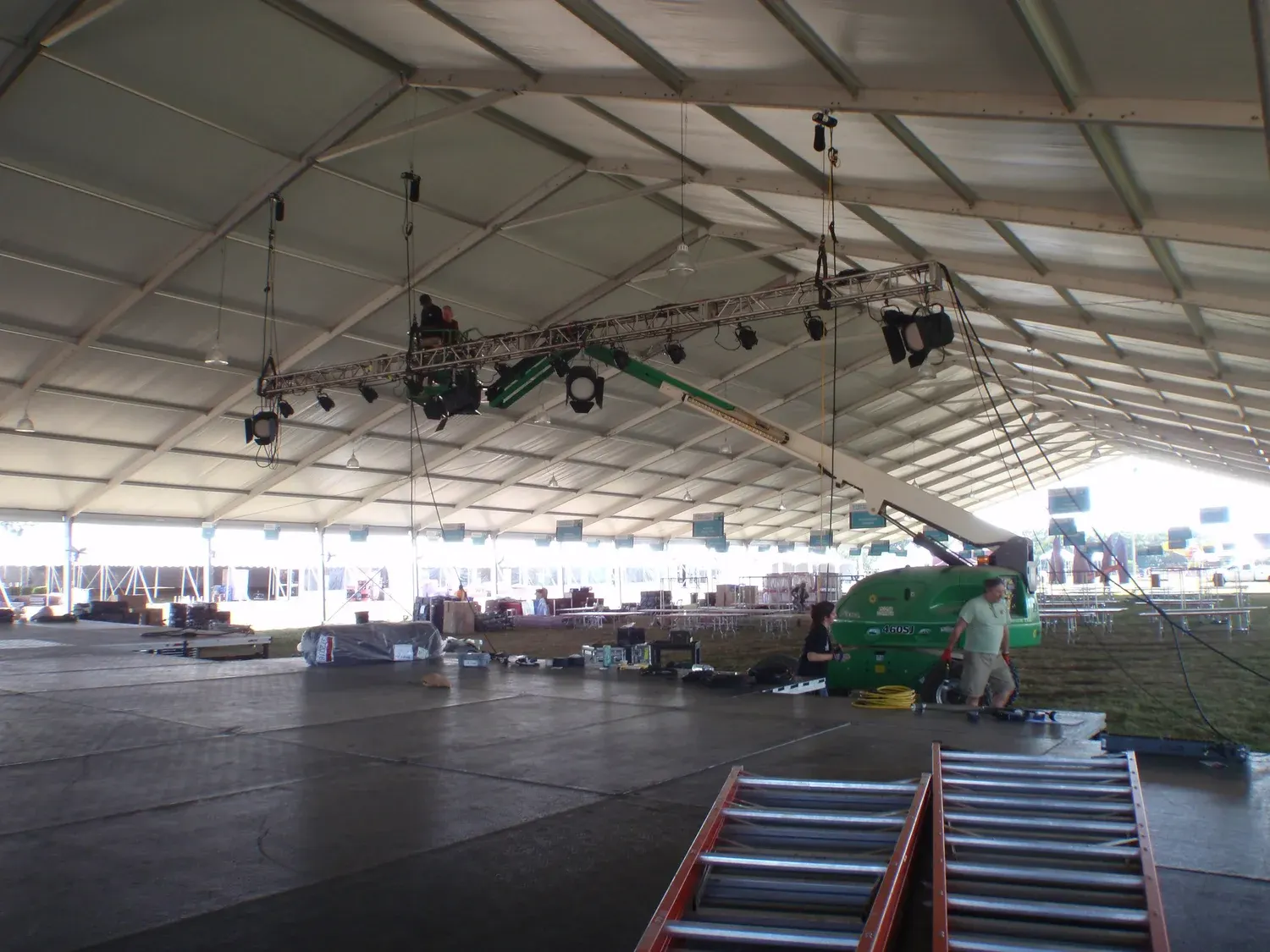
The overhead structure is the obvious part. Truss carries lighting fixtures, drapes, projection screens, and increasingly LED panels, which are considerably heavier per square foot than a screen and a projector. That structure has to be assembled correctly, connected to the building or to ground support, and lifted in a controlled way.
Then there is the load path. The weight does not stop at the truss. It goes into the motors, into the rigging hardware, into the venue’s own steel or beams, and eventually into the building’s structure. Every link in that chain has a rating, and the chain is only as strong as the weakest one.
And there is the human part: who is allowed to be under a load while it is moving, where the fall protection is, how the lift is operated, and who calls a stop when something does not look right.
Why LED changed the conversation
Videowalls have made rigging a bigger topic than it used to be. An LED wall is a genuine structural load, considerably heavier than a projection screen covering the same area, and it is concentrated rather than spread out.
That means two things for planners. First, the decision to use an LED wall is partly a venue decision, because not every room can take one where you want it. Second, the answer is sometimes ground support rather than hanging, and ground support takes floor space and needs dressing so it does not read as scaffolding from the guest tables.
Neither of those is a problem when it comes up in week one. Both are a problem when they come up on load in day.
The questions worth asking early
What does the venue allow, and what does it require
Venues vary enormously. Some have a house rigger who must be used. Some have specific attachment points and a published capacity for each. Some require certificates of insurance with particular limits, or a plot submitted for approval a set number of days in advance. Some do not permit anything to be hung at all, which changes the design entirely.
Ask the venue for its rigging policy and its technical packet at the same time you ask for the floor plan. Send both to your AV company. This is the single most useful thing a planner can do to keep a project moving.
Is there a rigging plot, and who drew it
For anything beyond a simple setup there should be a drawing showing what hangs where, what it weighs, and where the load goes. That plot is what the venue reviews and what the crew works from. It is also what makes it possible to answer a question like “can we move the screen four feet stage left” without guessing.
If nobody can produce a plot, that is worth noticing.
Who is doing the lifting, and what are they using
Lifts, motors, and hardware all need to be appropriate for the job and in good order. The crew operating them needs to know the equipment. This is ordinary professional practice, and it is the sort of thing that is either baked into how a company works or it is not.
What happens if something changes
Events change. The client adds a segment, the set grows, the sponsor sends a bigger banner. Every one of those is a load change, and it needs to go back through the same check rather than being absorbed on the day because there seems to be room. A good crew will tell you when a change means revisiting the plot. That is not obstruction, it is the process working.
The safety margin is not negotiable
The reason rigging costs what it costs is that it is designed with margin. Ratings are not targets to hit. Hardware is chosen so that the working load is a fraction of what the component can take, because real events involve dynamic loads, uneven distribution, and equipment that gets added after the plan was drawn.
When someone offers to do the same overhead package for meaningfully less, the question worth asking is where the margin went. Sometimes the answer is a genuinely more efficient design. Often it is fewer points, lighter hardware, or a crew doing something they should not be doing alone.
An audience is sitting under it. That is the whole argument.
What good rigging looks like from the outside
You will notice very little, which is the point. But there are signs.
The crew arrives with a plot and works from it. Somebody is clearly in charge of the lift and says so out loud. The area under a moving load is cleared and stays cleared. Hardware looks maintained rather than improvised. Nothing is hanging from something that was obviously meant for another purpose. When you ask what something weighs, you get a number rather than a shrug.
And when a change is requested, the answer is either a confident yes or a specific reason why not, rather than an uneasy attempt to make it work.
It is a design conversation, not a line item
The most useful thing to take from all of this is that rigging belongs in the first design conversation about your event, not the last cost review. What you can hang shapes the display, the lighting, and the look of the set. Knowing the constraints early lets a production team design something beautiful within them, instead of designing something first and discovering it will not fly.
Long Island Video has been designing and installing lighting and rigging systems for events across the tri-state area for over 35 years, on structures that carry lights, screens, and effects safely. If you are working in a room where you are not sure what can be hung, talk to us early or call 516 759 5483.