

Getting Clear Sound in a Room That Fights You
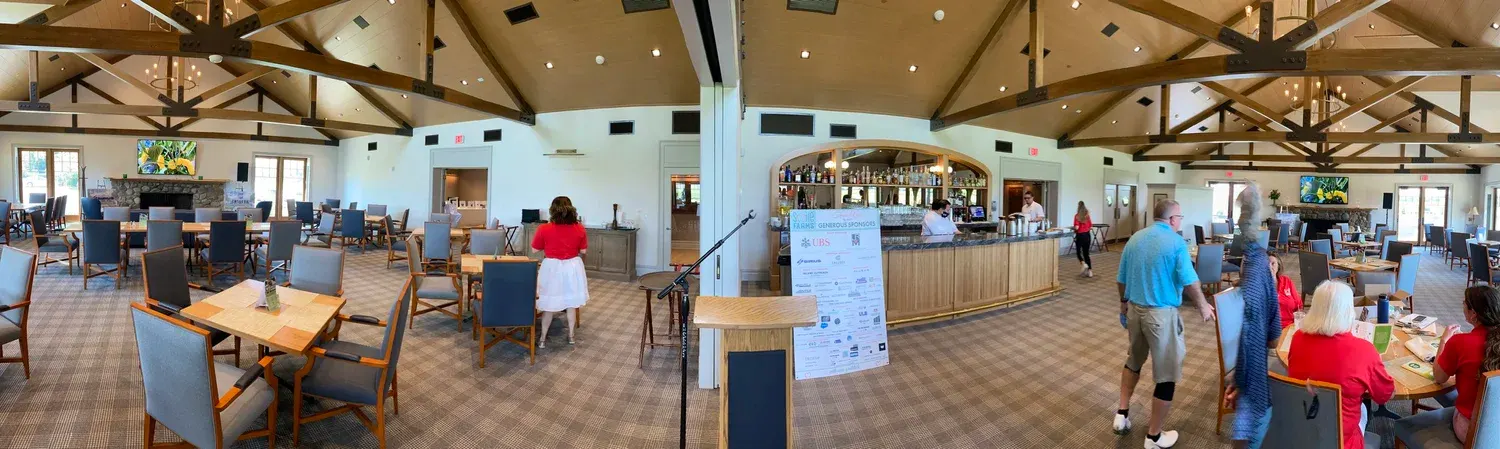
Every planner has been in this room. Beautiful space, exposed beams, a stone or wood floor, a wall of windows looking at something worth looking at. It photographs wonderfully. Then the first speaker takes the microphone and the back half of the audience stops following what is being said.
Nothing is broken. The room is simply doing what hard, reflective surfaces do: sending most of the energy back at the audience a fraction of a second late, over and over, until consonants smear into each other and speech turns into noise with a shape.
This is a solvable problem, but it is solved by design and placement rather than by volume. Turning the system up in a reverberant room adds energy to the reflections at the same rate it adds energy to the direct sound, so the ratio that determines whether people understand words does not improve. It just gets louder and harder to listen to.
Why a hard room makes speech hard to follow
What lets you understand a sentence is the direct sound reaching you before the reflected sound does, and clearly enough to stand out from it. In a carpeted, draped ballroom, most reflections are absorbed and the direct sound dominates easily.
In a room with a hard floor, glass, and a high vaulted ceiling, the reflections keep going. By the time the tail of one word is still bouncing around the room, the next two words have started. The audience hears them layered on top of each other. Music tolerates that surprisingly well, which is why a band can sound good in a room where a presentation is unintelligible. Speech does not.
There is a second factor people underestimate: the audience itself. A room measured empty and a room full of people in coats are meaningfully different acoustic spaces. The crowd absorbs a great deal. It is one reason a sound check at nine in the morning in an empty hall is only a starting point, not a final setting.
What actually helps
Get the loudspeakers closer to the people
The single most effective move in a difficult room is to reduce the distance between the loudspeaker and the listener. Less distance means more direct sound relative to reflected sound, and intelligibility rises without the overall level rising.
In practice that means more, smaller sources rather than fewer, larger ones. A pair of loudspeakers at the front of a long hard room has to be loud enough to reach the back, which means the front rows are punished and the back of the room is still hearing mostly reflections. The same room with additional loudspeakers placed further back, timed correctly so they reinforce rather than blur, is quieter at the front, clearer at the back, and more comfortable everywhere.
Aim the energy at the audience and away from the surfaces
Coverage is a design decision, not something you adjust on the day. Loudspeakers have a defined pattern, and the goal in a reflective room is to put that pattern on people and keep it off the glass, the ceiling, and the back wall.
A person absorbs sound. A window returns it. Choosing loudspeakers with appropriate directivity and aiming them deliberately is often the difference between a room that works and a room that does not, and it costs nothing extra once it is part of the plan.
Pick the right microphone, and put it in the right place
A lot of what gets diagnosed as a room problem starts at the microphone. A lectern microphone placed too far from a presenter who does not lean in has to be run at a much higher gain, which brings up the room, the air handling, and everything else along with the voice.
A lavalier or a headset places the element inches from the mouth and changes the whole equation. Every decibel of level you gain at the source is a decibel you do not have to gain in the system, which means less energy going into the room and more headroom before feedback.
Panels deserve particular attention. Several open microphones in a live room is the standard recipe for feedback, and the fix is in the choice and placement of the microphones and in how the system is set up, not in someone riding faders during the session.
Deal with the low end
Reverberant rooms usually have too much low frequency energy, and low frequencies are exactly what muddies speech. A careful bit of shaping in the system, taking down what the room is already adding, does more for clarity than any amount of extra level. It sounds thinner in isolation. It sounds far better in the room.
What does not help
Turning it up. Already covered, and worth repeating because it is the instinct.
Assuming the house system will do it. Many venues have a distributed ceiling system meant for background music and announcements. It is not designed for a presentation to an audience seated for an hour, and it usually has no useful coverage control. It is worth checking what the house system actually is rather than assuming a system exists and will be adequate.
Adding a few pipe and drape panels at the last minute. Soft goods do help, but the amount of absorption needed to change a large hard room is far more than most events can hang, and drape does very little at the frequencies that matter for muddiness. Treat it as a small improvement, not a solution.
Testing an empty room and stopping there. Check it empty, then listen again once people are in, and be prepared to adjust. Any competent crew expects this.
Ask the venue question early
If your event is going into a room like this, say so when you brief the AV company. Describe the surfaces: the floor, the ceiling height, the windows, whether there are drapes. Say whether there is a hard back wall or a soft one. If you can, arrange for the AV team to stand in the room and clap once, which tells an experienced ear a surprising amount in about a second.
Rooms like this are not a reason to walk away from a venue you love. They are a reason to design the sound around the room you are actually in, early enough that the design can include the extra positions, the right coverage, and the cabling to support it. That is a planning decision, and it is cheap in week one and impossible on show day.
Long Island Video builds event sound systems around the venue, the acoustics, and the audience, from a boardroom of a dozen people to a hall of thousands. If you have a beautiful room with a difficult sound problem, tell us about it or call 516 759 5483.