
Projection or LED: Choosing the Display Your Room Can Actually Support
The question arrives in most event conversations sooner or later. Should we project, or should we put up an LED videowall? It is usually framed as a budget question, and it partly is, but the more useful way to ask it is this: what is the room going to do to the image?
Both technologies are excellent when they are used in the conditions they were designed for. Both look disappointing outside those conditions. The decision is less about which is better and more about which one your specific room, your specific lighting plan, and your specific content can support.
The first question is always ambient light
Projection puts light onto a surface. Anything else putting light onto that same surface competes with it. That includes house lights, window light, stage wash spilling past the edge of the platform, and the uplighting somebody added to the room after the AV was designed.
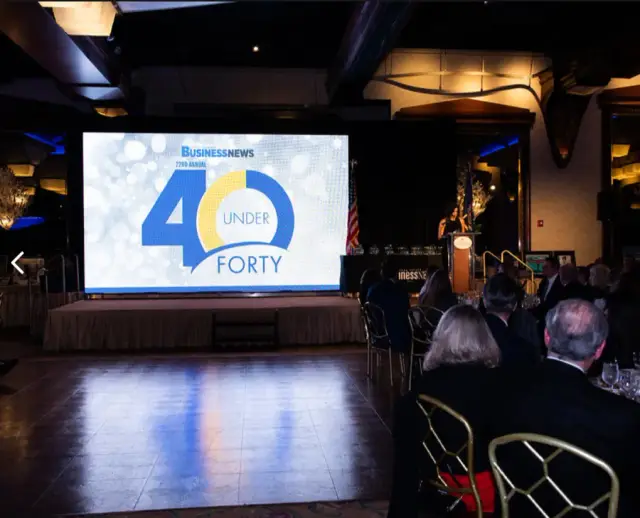
An LED wall emits its own light. It does not care nearly as much what else is happening in the room, which is why it is the answer for a bright ballroom with chandeliers on, an atrium with a glass wall, or any daytime event where the client wants the room lit and lively rather than dimmed to a cinema.
So before anything else, ask what the room will look like at the moment the screen matters most.
Where projection still wins
Do not read that as projection being the compromise. In a room you can control, projection produces a very large image at a cost per square foot that LED cannot approach, and a big image is often exactly what a general session needs.
It also disappears. A projection screen in a well dressed ballroom reads as part of the set. It has no visible frame of panels, no bezel pattern, no seams, and when it is not in use it is a neutral surface. For a gala where the room design is the point and the content is occasional, that matters.
Projection is also more forgiving about last-minute scale changes. Going from a wider screen to a narrower one is often a surface change rather than a redesign.
Where LED earns its keep
An LED wall holds up under house lights, which means the room does not have to go dark for the content to read. It has consistent brightness and color across the whole surface, and it does not soften as it gets bigger. It can be built in shapes a screen cannot: a long low band behind a panel, a curve, or a wall broken into separate blocks as part of the set.
For anything where the display itself is meant to be part of the scenic design rather than a window in the middle of it, LED is usually the honest answer.
Then look up, and look at the floor
Ceiling height sets the bottom of the image
Whichever technology you pick, the person in the last row has to see the bottom of the slide over the heads in front of them. That is a geometry problem, and ceiling height is the constraint.
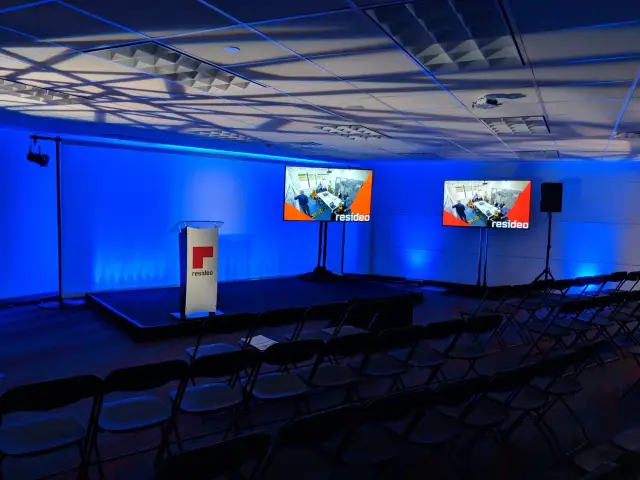
A room with a generous ceiling can fly a large screen high enough that everybody sees all of it. A low ceiling cannot, no matter how big the screen is, and the answer there is usually more displays rather than one larger one. Two side screens at the front, or a pair of delay displays partway back, will serve a long room better than a single wall that half the audience is looking at through somebody’s hairstyle.
LED is heavy, and the floor or the ceiling has to take it
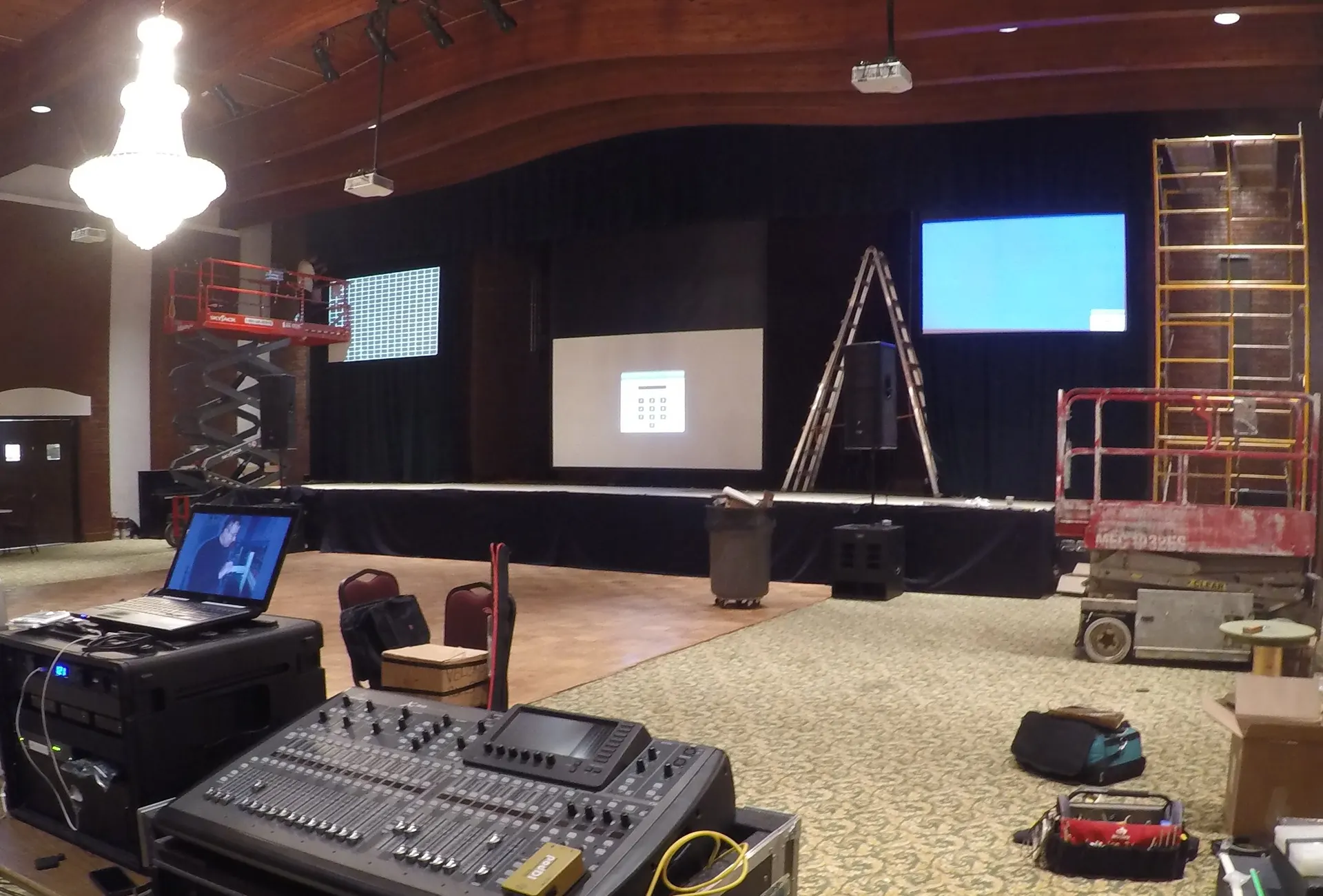
An LED wall is a structure. It either hangs from rigging points or it sits on ground support, and either way somebody has to confirm the venue can take the load. That is a conversation with the venue and with a rigger, and it happens during design, not on load in day.
Ground support is a perfectly good solution. It just occupies floor space behind and beside the wall, which comes out of the room, and it needs to be dressed so it does not read as scaffolding from the guest tables.
Content decides more than people expect
Look at what is actually going on screen before you choose.
Dense slides with small text, spreadsheets, or detailed charts want resolution and short viewing distances. A speaker’s face at large scale wants an image that holds skin tones and does not band in gradients. A branded loop and a countdown clock will look good on nearly anything.
Ask the practical question: what is the smallest thing anybody has to read, and how far away is the furthest seat from it? That single ratio does more to size a display than any product specification.
It is also worth insisting that presenters build slides for the room rather than for their laptop screen. The most common legibility failure at events is not the display technology. It is nine-point type in a footnote on a slide built at a desk.
Cameras change the answer again
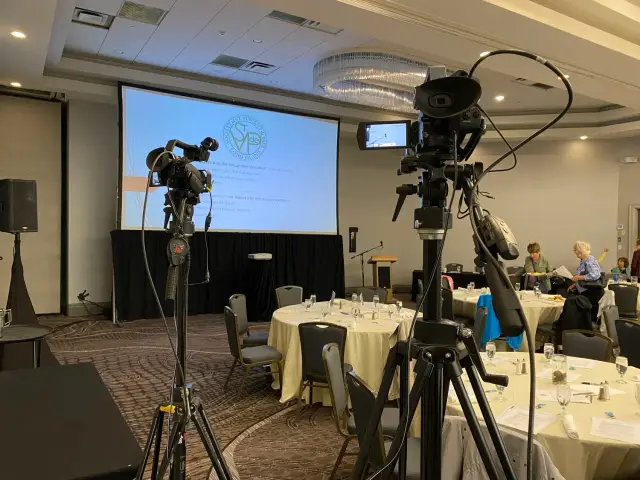
If the event is being recorded or streamed, the display becomes something the camera has to look at as well as the audience.
Cameras and displays can disagree. Refresh rates and shutter speeds interact, and the fix is in the setup and the camera settings rather than something to discover in the edit. Brightness matters too: a display bright enough to hold up under house lights can overexpose in a shot where the presenter in front of it is properly lit.
None of that is a reason to avoid either technology. It is a reason to say early in the brief that there will be cameras, so the display and the lighting are designed together with that in mind.
A short way to decide
If the room has to stay bright, if the display is part of the set, or if the content is on screen continuously, look at LED first.
If you can control the light, if you want the largest possible image for the money, or if the screen should vanish into a dressed room, look at projection first.
If the room is long, if the ceiling is low, or if the seating wraps, the real answer is often more than one display rather than a bigger one, whichever technology you land on.
And in every case, walk the room. A floor plan will tell you the dimensions. Standing in the back corner tells you what the audience is going to experience.
Long Island Video has been designing displays for events across the New York metropolitan region for over 35 years, from single-screen projections to multi-display videowalls. If you want a straight answer about what will work in your room, tell us about the event or call 516 759 5483.