
Outdoor and Tented Events: The AV Questions Worth Asking Early
Long Island runs a lot of its best events outdoors. Graduations on a field, galas under a tent, ceremonies on a lawn, summer parties at a club or a winery. They are also the events where audio-visual problems are hardest to fix once the day arrives, because most of the usual assumptions do not hold.
None of this makes an outdoor event difficult. It makes it a different set of questions, and the questions are much cheaper to answer in August than in the last week.
Sound does not behave the way it does indoors
A room helps you. Walls and a ceiling keep sound where you put it, so a modest system fills the space and everyone hears roughly the same thing.
Outdoors there is nothing to contain it. Sound leaves and does not come back, which changes the design in three ways.
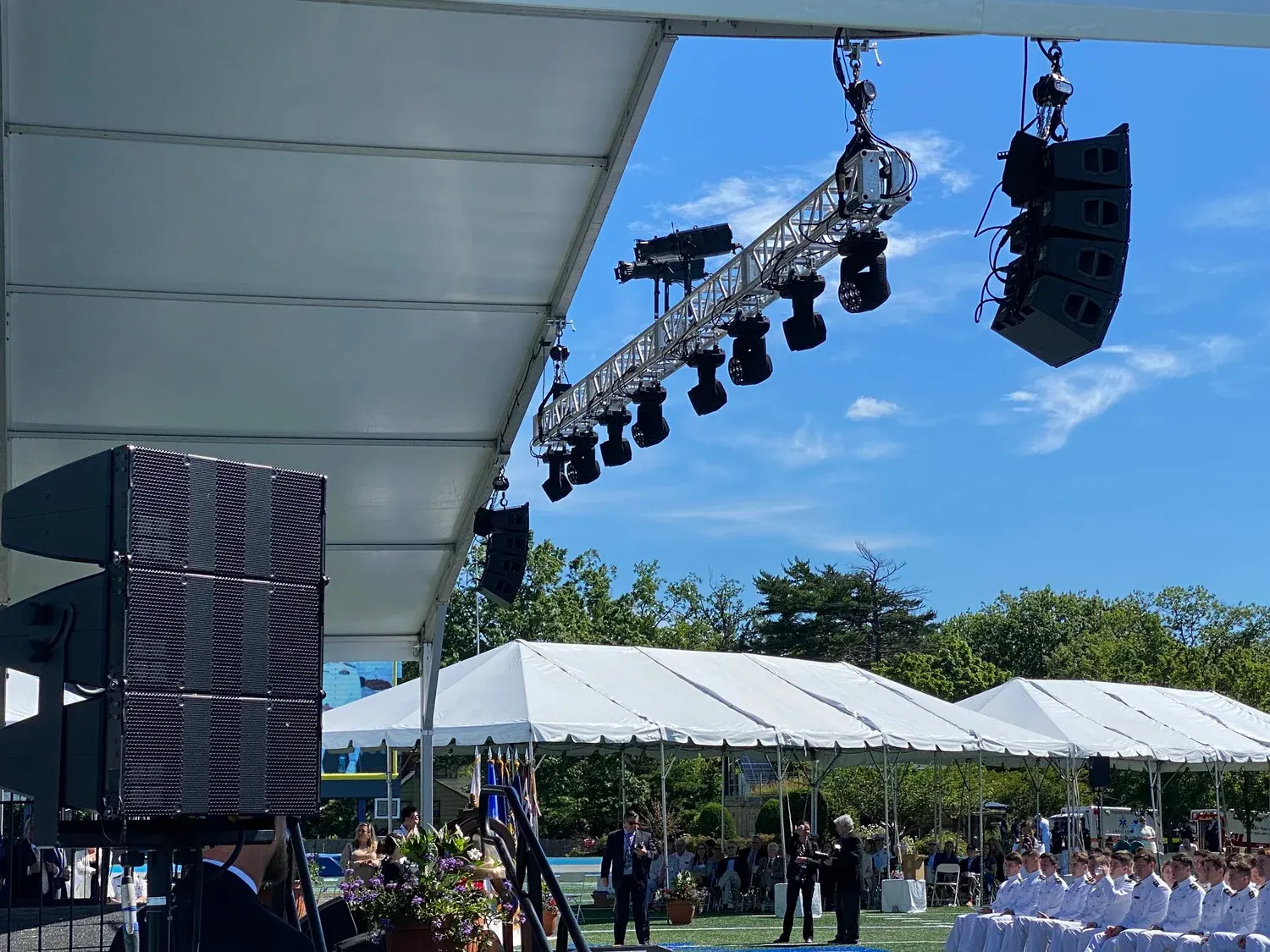
You need more coverage than the headcount suggests. Not more volume at the front, which only punishes the first few rows. More speakers, spread out, so the back is not being served by a system aimed at the front.
Wind is real. It moves sound around, and it makes microphones difficult. A lectern microphone that is perfect in a ballroom can be unusable in a breeze. This is a microphone choice, and it should be made knowing the event is outside.
Neighbors exist. Sound that leaves your field goes somewhere. Some venues and some towns have limits, and it is worth asking what they are before the design rather than during the event.
A tent sits in between. It gives you a ceiling and some containment, which helps, and it introduces its own problem: tent walls flap, and canvas is a reflective surface that does unhelpful things to speech if the speakers are pointed at it.
Power is almost never where you want it
The single most common outdoor surprise is power. Not the amount of it, the location and the quality.
Ask three things early. Where is the nearest usable power, and how far is that from where the stage is going? Is it a circuit that already has something else on it, like catering or a field’s own lighting? And if the answer is a generator, who is supplying it and is it a quiet one?
Generators are normal and fine. A generator parked near the seating is not, and neither is one that arrives without enough cable to sit somewhere sensible. Both are trivial to solve when they are known in advance.
Daylight is a display decision
An outdoor screen in daylight is a different product from an indoor one. Projection needs darkness and outdoor events rarely have it, so the honest answer for a daytime event is usually LED, which is bright enough to hold up in sun.
That has consequences worth knowing. LED is heavier and needs either ground support or a structure rated to carry it. It costs more than projection. And it needs to be positioned with the sun in mind, because a screen the audience has to look toward the sun to see is not solving the problem.
For an evening event the calculation reverses and projection may be the better answer, as long as the timeline accounts for how long it stays light in June.
Weather is a design input, not a risk to accept
Every outdoor event has a weather plan. The useful question is whether the AV is genuinely part of it.
Equipment does not like water. Covering it is a physical task that takes people and time, and it has to be decided who does that and on whose call. A tent changes the sound design, so “we will put a tent up if it rains” is a different event, not a contingency. And if there is an indoor alternate space, somebody should have looked at it, because moving a production indoors on the morning is only possible if the indoor room was part of the plan.
The events that handle weather well are the ones where the decision point was agreed in advance: who decides, by what time, and what happens in each case.
Getting in and getting out
Outdoor sites are harder to load into than buildings. Grass does not take heavy cases well, especially after rain. Vehicles may not be able to reach the stage position. There may be no lighting once the sun goes down, which matters at strike more than at load in, because strike happens in the dark after a long day.
Ask about vehicle access, ground conditions, and what time you have to be off the site. The last one catches people out regularly.
The short version
Walk the site with your AV company, in daylight, early enough to change things. Bring the venue. Settle power, screen position, the weather decision point and the get-out time while they are still cheap to settle.
We produce outdoor and tented events across Long Island, from graduations and ceremonies to tented galas and summer corporate days. If you have a site and a date, let us walk it with you.